Elephant Communication
O' Connell-Rodwell, a postdoctoral fellow at Stanford University, has travelled to Namibia's first-ever wildlife reserve to explore the mystical and complicated realm of elephant communication. She, along with her colleagues, is part of a scientific revolution that started almost 20 years ago. This revolution has made a stunning revelation: elephants are capable of communicating with each other over long distances with low-frequency sounds, also known as infrasounds, which are too deep for humans to hear.
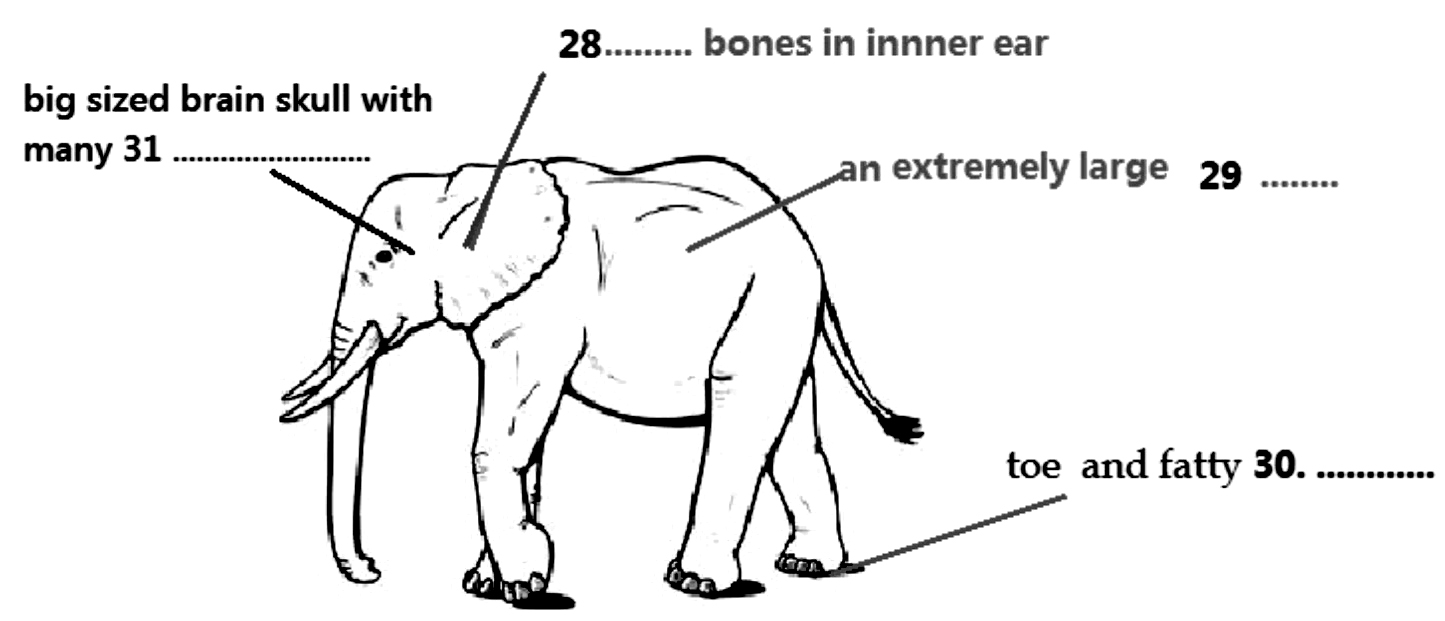
As might be expected, African elephants able to detect seismic sound may have something to do with their ears. The hammer bone in an elephant's inner ear is proportionally huge for a mammal, but it is rather normal for animals that use vibrational signals. Thus, it may be a sign that suggests elephants can use seismic sounds to communicate.
Other aspects of elephant anatomy also support that ability. First, their massive bodies, which enable them to give out low-frequency sounds almost as powerful as the sound a jet makes during takeoff, serve as ideal frames for receiving ground vibrations and transmitting them to the inner ear. Second, the elephant's toe bones are set on a fatty pad, which might be of help when focusing vibrations from the ground into the bone. Finally, the elephant has an enormous brain that sits in the cranial cavity behind the eyes in line with the auditory canal. The front of the skull is riddled with sinus cavities, which might function as resonating chambers for ground vibrations.
It remains unclear how the elephants detect such vibrations, but O' Connell-Rodwell raises a point that the pachyderms are 'listening' with their trunks and feet instead of their ears. The elephant trunk may just be the most versatile appendage in nature. Its utilization encompasses drinking, bathing, smelling, feeding and scratching. Both trunk and feet contain two types of nerve endings that are sensitive to pressure – one detects infrasonic vibration, and another responds to vibrations higher in frequencies. As O' Connell-Rodwell sees, this research has a boundless and unpredictable future. 'Our work is really interfaced of geophysics, neurophysiology and ecology,' she says. 'We're raising questions that have never even been considered before.'
It has been well-known to scientists that seismic communication is widely observed among small animals, such as spiders, scorpions, insects and quite a lot of vertebrate species like white-lipped frogs, blind mole rats, kangaroo rats and golden moles. Nevertheless, O'Connell-Rodwell first argued that a giant land animal is also sending and receiving seismic signals. 'I used to lay a male planthopper on a stem and replay the calling sound of a female, and then the male one would exhibit the same kind of behaviour that happens in elephants—he would freeze, then press down on his legs, move forward a little, then stay still again. I find it so fascinating, and it got me thinking that perhaps auditory communication is not the only thing that is going on.'
Scientists have confirmed that an elephant's capacity to communicate over long distance is essential for survival, especially in places like Etosha, where more than 2,400 savanna elephants range over a land bigger than New Jersey. It is already difficult for an elephant to find a mate in such a vast wild land, and the elephant reproductive biology only complicates it. Breeding herds also adopt low-frequency sounds to send alerts regarding predators. Even though grown-up elephants have no enemies else than human beings, baby elephants are vulnerable and are susceptible to lions and hyenas attack. At the sight of a predator, older ones in the herd will clump together to form protection before running away.
We now know that elephants can respond to warning calls in the air, but can they detect signals transmitted solely through the ground? To look into that matter, the research team designed an experiment in 2002, which used electronic devices that enabled them to give out signals through the ground at Mushara. 'The outcomes of our 2002 study revealed that elephants could indeed sense warning signals through the ground,' O'Connell-Rodwell observes.
Last year, an experiment was set up in the hope of solving that problem. It used three different recordings—the 1994 warning call from Mushara, an anti-predator call recorded by scientist Joyce Poole in Kenya and a made-up warble tone. 'The data I've observed to this point implies that the elephants were responding the way I always expected. However, the fascinating finding is that the anti-predator call from Kenya, which is unfamiliar to them, caused them to gather around, tense up and rumble aggressively as well—but they didn't always flee. I didn't expect the results to be that clear-cut.
Label the diagram below.
Choose NO MORE THAN TWO WORDS from the passage for each answer. Write your answers in boxes 28-31 on your answer sheet.
Complete the summary below.
Choose NO MORE THAN THREE WORDS from the passage for each answer. Write your answers in boxes 32-38 on your answer sheet.
How the elephants sense these sound vibrations is still unknown, but O'Connell-Rodwell, a postdoctoral researcher at Stanford University, proposes that elephants are 'listening' with their 32________ by two kinds of nerve endings that respond to vibrations with both 33________ frequency and slightly higher frequencies. O'Connell-Rodwell's work is at the combination of geophysics, neurophysiology and 34________ . It was known that seismic communication existed extensively within small animals, but O'Connell-Rodwell was the first person to indicate that a large land animal would send and receive 35________ too. Also, he noticed the freezing behaviour by putting a male planthopper on a stem and play back a female call, which might prove the existence of other communicative approaches besides 36________. Scientists have determined that an elephant's ability to communicate over long distances is essential, especially, when elephant herds are finding a 37________ , or are warning of predators. Finally, the results of our 2002 study showed us that elephants could detect warning calls through the 38________.
Choose the correct letter, A, B, C or D
Write the correct letter in boxes 39-40 on your answer sheet.
39 According to the passage, it is determined that an elephant needs to communicate over long distances for its survival
A when a threatening predator appears.
B when young elephants meet humans.
C when older members of the herd want to flee from the group.
D when a male elephant is in estrus.
40 What is the author's attitude toward the experiment by using three different recordings in the last paragraph?
A The outcome is definitely out of the original expectation.
B The data cannot be very clearly obtained.
C The result can be somewhat undecided or inaccurate.
D The result can be unfamiliar to the public.
28 Hammer
29 body
30 pad(s)
31 sinus cavities
32 trucks and feet
33 infrasonic/low
34 ecology
35 seismic signals
36 auditory communiation
37 mate
38 ground
39 A
40 C
Tiến sĩ O' Connell-Rodwell, nghiên cứu sinh sau tiến sĩ tại Đại học Stanford, đã đến khu bảo tồn động vật hoang dã đầu tiên của Namibia để khám phá thế giới bí ẩn và phức tạp trong cách giao tiếp của loài voi. Cô cùng các đồng nghiệp là một phần của cuộc cách mạng khoa học bắt đầu cách đây gần 20 năm. Cuộc cách mạng này đã mang đến một tiết lộ đáng kinh ngạc: voi có khả năng giao tiếp với nhau qua những khoảng cách xa bằng âm thanh tần số thấp, còn được gọi là hạ âm, là những âm thanh quá trầm mà con người không thể nghe được.
Không có gì ngạc nhiên, khả năng phát hiện âm thanh địa chấn của voi châu Phi có thể liên quan đến đôi tai của chúng. Xương búa trong tai trong của voi có kích thước khổng lồ so với các loài động vật có vú, nhưng lại khá bình thường đối với những loài sử dụng tín hiệu rung động. Do đó, đây có thể là dấu hiệu cho thấy voi có thể sử dụng âm thanh địa chấn để giao tiếp.
Các khía cạnh khác về giải phẫu của voi cũng hỗ trợ khả năng này. Thứ nhất, thân hình đồ sộ của chúng, cho phép chúng phát ra âm thanh tần số thấp gần như mạnh mẽ như tiếng máy bay phản lực cất cánh, đóng vai trò như một khung lý tưởng để tiếp nhận rung động mặt đất và truyền chúng đến tai trong. Thứ hai, xương ngón chân của voi được đặt trên một miếng đệm mỡ, có thể hỗ trợ việc tập trung rung động từ mặt đất vào xương. Cuối cùng, voi có bộ não khổng lồ nằm trong khoang sọ sau mắt, thẳng hàng với ống dẫn thính giác. Phía trước hộp sọ có nhiều xoang xoáy, có chức năng như buồng cộng hưởng cho các rung động mặt đất.
Hiện vẫn chưa rõ làm cách nào loài voi có thể phát hiện ra những rung động như vậy, nhưng O' Connell-Rodwell đưa ra quan điểm rằng loài voi đang 'lắng nghe' bằng vòi và bàn chân thay vì bằng tai. Vòi của voi có thể là phần phụ đa năng nhất trong tự nhiên. Công dụng của nó bao gồm uống nước, tắm, ngửi, ăn và gãi. Cả vòi và chân đều chứa hai loại đầu dây thần kinh nhạy cảm với áp lực - một loại cảm nhận rung động tần số thấp, loại còn lại phản ứng với rung động tần số cao hơn. Theo O' Connell-Rodwell, nghiên cứu này có một tương lai vô cùng rộng lớn và khó đoán định. "Công việc của chúng tôi thực sự là sự giao thoa giữa địa vật lý, sinh lý thần kinh và sinh thái học," cô nói. "Chúng tôi đang đặt ra những câu hỏi chưa từng được cân nhắc trước đây."
Các nhà khoa học đã biết rằng giao tiếp địa chấn được quan sát rộng rãi ở các loài động vật nhỏ, chẳng hạn như nhện, bọ cạp, côn trùng và khá nhiều loài động vật có xương sống như ếch môi trắng, chuột chũ mù, chuột túi kangaroo và chuột chũ vàng. Tuy nhiên, O'Connell-Rodwell là người đầu tiên cho rằng một loài động vật trên cạn khổng lồ cũng đang gửi và nhận tín hiệu địa chấn. "Tôi từng đặt một con bọ hoãng đực lên thân cây và phát lại tiếng gọi của con cái, sau đó con đực sẽ thể hiện cùng một kiểu hành vi giống như ở loài voi - nó sẽ đứng bất động, sau đó ấn chân xuống đất, di chuyển về phía trước một chút, rồi lại đứng yên. Tôi thấy điều đó thật hấp dẫn, và nó khiến tôi nghĩ rằng có lẽ giao tiếp bằng thính giác không phải là thứ duy nhất đang diễn ra."
Các nhà khoa học đã xác nhận rằng khả năng giao tiếp qua khoảng cách xa của voi là cần thiết để sinh tồn, đặc biệt ở những nơi như Etosha, nơi hơn 2.400 con voi đồng cỏ di chuyển trên một vùng đất rộng hơn cả New Jersey. Việc tìm bạn đời trong một vùng đất hoang dã rộng lớn như vậy vốn đã khó khăn, và sinh học sinh sản của voi càng khiến việc này trở nên phức tạp. Đàn sinh sản cũng sử dụng âm thanh tần số thấp để gửi cảnh báo về kẻ săn mồi. Mặc dù voi trưởng thành không có kẻ thù nào khác ngoài con người, nhưng voi con lại rất dễ bị tổn thương và có thể bị sư tử và linh cẩu tấn công. Khi nhìn thấy kẻ săn mồi, những con voi già hơn trong đàn sẽ tập hợp lại để tạo thành lớp bảo vệ trước khi bỏ chạy.
Bây giờ chúng ta đã biết voi có thể phản ứng với tiếng gọi cảnh báo trên không, nhưng chúng có thể phát hiện tín hiệu truyền qua mặt đất không? Để tìm hiểu vấn đề đó, nhóm nghiên cứu đã thiết kế một thí nghiệm vào năm 2002, sử dụng các thiết bị điện tử cho phép phát tín hiệu qua mặt đất tại Mushara. "Kết quả nghiên cứu năm 2002 của chúng tôi cho thấy voi thực sự có thể cảm nhận tín hiệu cảnh báo qua mặt đất," O'Connell-Rodwell nhận xét.
Năm ngoái, một thí nghiệm đã được thiết lập với hy vọng giải quyết vấn đề đó. Nó sử dụng ba bản ghi âm khác nhau - tiếng gọi cảnh báo năm 1994 từ Mushara, tiếng gọi chống lại kẻ săn mồi được nhà khoa học Joyce Poole ghi lại ở Kenya và một âm báo chế tạo. "Dữ liệu mà tôi quan sát cho đến thời điểm này cho thấy lũ voi đang phản ứng theo cách tôi luôn mong đợi. Tuy nhiên, phát hiện thú vị là tiếng gọi chống lại kẻ săn mồi từ Kenya, thứ xa lạ với chúng, khiến chúng tập hợp lại, căng thẳng và gầm gừ hung dữ - nhưng chúng không phải lúc nào cũng bỏ chạy. Tôi không ngờ kết quả lại rõ ràng như vậy."