Renewable energy
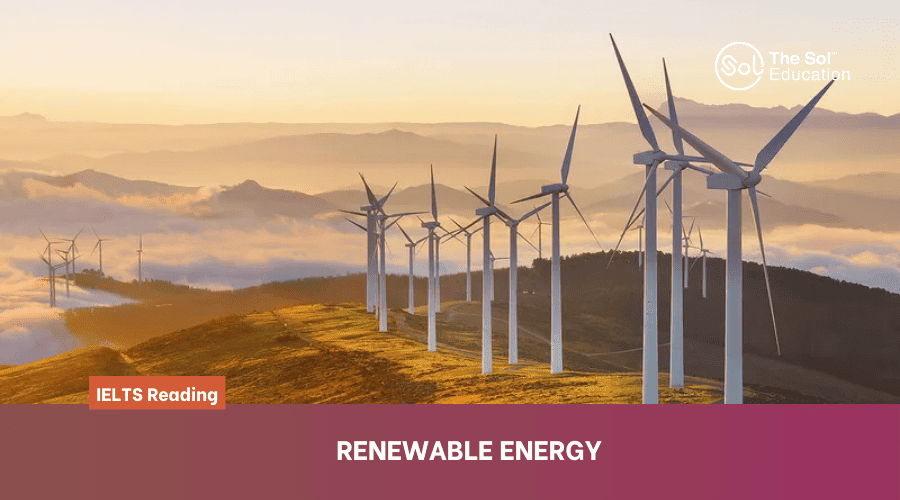
An insight into the progress in renewable energy research
Renewable energy, also known as alternative energy, can be gained from such non-fossil sources as wind, sun and wave. The overwhelming majority of the world's energy supply is still derived from fossil fuels now, say coal and natural gas, which are scarce resources. But according to a new report from International Renewable Energy Agency (IRENA), the costs of generating electricity from onshore wind have fallen by around 25% since 2010 while the costs of solar photovoltaic electricity by 70%. The report also indicates that all forms of alternative energy should be competitive in price with fossil fuels by 2020. In Australia, some modern technologies are aiming to be the first to push coal from its position as the country's main source of electricity.
Currently, the front-runner in renewable energy is wind technology, which started to expand in the early 21st century. Peter Bergin, from Australian Hydro, one of Australia's leading wind energy companies, points out there have been no remarkable changes in windmill design for many years. Still, the cumulative effects of numerous small improvements have made a difference to the costs. 'We're reaping the benefits of 30 years of research in Europe, without having to make the same mistakes that they did,' says Mr. Bergin.
Electricity generated from coal is at around 4 cents per kilowatt-hour, but the environmental costs are not incorporated in the price. 'Australia has the second cheapest electricity in the world, which makes it difficult for alternative energy to compete,' says Richard Hunter of the Australian Eco-generation Association (AEA). Nevertheless, the production costs of a kilowatt-hour of wind power have dramatically decreased during the last 20 years, according to the AEA's report.
Australian Hydro possesses dozens of wind monitoring stations across Australia as part of its aim to become Australia's pre-eminent renewable energy company. Despite all these developments, wind power remains one of the few alternative energy sources where Australia is nowhere near the global cutting edge, mostly just replicating European designs.
In spite of the leading role of wind in Australia, other technologies capable of providing more reliable power have more potential in the future. In several cases, Australia is at the forefront of global research in the area. One of such developments uses hot, dry rocks. In the deep layers beneath South Australia, radiation from elements contained in the granite heats the rocks. And the temperatures in some locations are raised by layers of insulating sedimentation to 250 degrees centigrade. An Australian firm, Geo Energy, is proposing to pump water 3.5 kilometres into the earth, where it will travel through tiny fissures in the granite, heating up as it goes, until it escapes as steam through another drilled hole.
No greenhouse gas is emitted, but the system needs some additional features if it is not going to have any detrimental effects on the environment. Dr. Prue Chopra, a geophysicist at the Australian National University and one of the founders of Geo Energy, notes that the steam will bring with it the radon gas, along through a heat exchanger and then sent back underground for another cycle. Hot, dry rocks are not a renewable source of energy in technique. However, the abundance of this resource in Australia could satisfy the entire country's needs for thousands of years at the current rate of consumption.
Two other proposals for very different ways to exploit sun and wave energy have also been put forward recently. Progress continues with Australian company Enviro Power's plan for Australia's first solar chimney near Mildura in Victoria. This scheme makes it possible for a tall tower to draw hot air from a greenhouse built to cover the surrounding 5 km2. As the air rises, it will drive a turbine to produce electricity. Three very old technologies are applied to the tower – the chimney, the turbine and the greenhouse – to produce something quite new. The very reliance on proven engineering principles has led Enviro Power's CEO, Richard Davies, to state: 'There is no doubt this technology will work, none at all.'
This year, Enviro Power has recognised that the sunlight collection in the Mildura district requires a substantially larger collecting area than was previously thought. However, spokesperson Kay Firth says that a new place closer to Mildura will enable Enviro Power to balance the increased costs with extra revenue. In addition to saving the transmission costs, the new site will mean the increased revenue from tourism and the use of power for tele- communications. We'll also be able to use the outer 500 m2 for agribusiness since the wind speed closer to the tower will be too high for farming.
Another Australian company, WaveTech, is achieving success by harvesting energy in waves, which has opened up a new prospect for alternative energy production. WaveTech's invention uses a curved surface to push waves into a chamber, where the flowing water column pushes air back and forth through a turbine. WaveTech was created when Dr. Tim Devine offered the idea to the world leader in wave generator manufacturers, who surprisingly rejected it. Dr. Devine responded by establishing WaveTech and making a series of other innovations to generator design. WaveTech claims that, at appropriate sites, the costs of electricity produced with their technology should be below 4 cents per kilowatt-hour.
The diversity of forms of greenhouse-friendly energy under development in Australia is noteworthy. However, support on a national level is disappointing. According to Richard Hunter of the AEA, 'Australia has huge potential for wind, sun and wave technology. We should really be on the front rank, but the reality is we are a long way behind.'
Do the following statements agree with the information given in Reading Passage 2?
In boxes 14–20 on your answer sheet, write
TRUE if the statement agrees with the information
FALSE if the statement contradicts the information
NOT GIVEN if there is no information on this
1 Variations in windmill design have had a big impact on the environment.
2 In Australia, alternative energy is less expensive than conventional energy.
3 Geo Energy needs to adapt its system to make it less harmful to the environment.
4 Hot, dry rocks could provide enough power for the whole of Australia.
5 Enviro Power's new facility will keep tourists away.
6 WaveTech was established when its founder was turned down by another company.
7 According to the AEA, Australia is leading the world in developing renewable energy.
Look at the following statements (Questions 21–26) and the list of companies below. Match each statement with the correct company, A, B, C or D.
Write the correct letter, A, B, C or D, in boxes 21–26 in your answer sheet. NB You may use any letter more than once.
List of Companies
A Australian Hydro
B Geoenergy
C Enviropower
D Wavetech
21 During the process, harmful substances are prevented from escaping.
22 Water is used to force air through a special device.
23 Techniques used by other countries are being copied.
24 The system can provide services other than energy production.
25 It is planning to force water deep under the ground.
26 The original estimate for part of the project needs to be revised.
Reading passage 2 has eight paragraphs, A-H.
Choose the correct heading for paragraphs A-H from the list of headings below. Write the correct number, i-xi, in boxes 14-21 on your answer sheet.
List of Headings
i The advantage of Morse's invention
ii A suitable job for women
iii Morse's invention was developed
iv Sea rescue after the invention of radiotelegraphy
v The emergence of many job opportunities
vi Standard and variations
vii Application of Morse code in a new technology
viii The discovery of electricity
ix International expansion of Morse Code
x The beginning of an end
xi The move of using code to convey information
14 Paragraph A
15 Paragraph B
16 Paragraph C
17 Paragraph D
18 Paragraph E
19 Paragraph F
20 Paragraph G
21 Paragraph H
14 Not Given
15 False
16 True
17 True
18 False
19 True
20 False
21 B
22 D
23 A
24 C
25 B
26 C
Một cái nhìn sâu sắc về sự tiến bộ trong nghiên cứu năng lượng tái tạo.
Năng lượng tái tạo, còn được gọi là năng lượng thay thế, có thể thu được từ các nguồn phi hóa thạch như gió, mặt trời và sóng. Phần lớn nguồn cung cấp năng lượng của thế giới hiện nay vẫn có nguồn gốc từ nhiên liệu hóa thạch, như than đá và khí đốt tự nhiên, những nguồn tài nguyên khan hiếm. Nhưng theo một báo cáo mới của Cơ quan Năng lượng tái tạo quốc tế (IRENA), chi phí sản xuất điện từ gió đã giảm khoảng 25% kể từ năm 2010 trong khi chi phí sản xuất quang năng giảm 70%. Báo cáo cũng chỉ ra rằng tất cả các dạng năng lượng thay thế phải có khả năng cạnh tranh về giá với nhiên liệu hóa thạch vào năm 2020. Tại Úc, một số công nghệ hiện đại đang hướng tới mục tiêu trở thành công ty đầu tiên loại bỏ than khỏi nguồn điện chính của đất nước.
Hiện nay, năng lượng đi đầu trong lĩnh vực năng lượng tái tạo là công nghệ gió, bắt đầu mở rộng vào đầu thế kỷ 21. Peter Bergin, từ Australian Hydro, một trong những công ty năng lượng gió hàng đầu của Australia, chỉ ra rằng không có thay đổi đáng chú ý nào trong thiết kế cối xay gió trong nhiều năm. Tuy nhiên, tác động tích lũy của nhiều cải tiến nhỏ đã tạo ra sự khác biệt về chi phí. Ông Bergin nói: “Chúng tôi đang thu được những lợi ích sau 30 năm nghiên cứu ở Châu Âu mà không phải mắc phải những sai lầm tương tự như họ đã mắc phải”.
Điện được tạo ra từ than mất khoảng 4 xu mỗi kilowatt giờ, nhưng đó chưa bao gồm các chi phí môi trường. Richard Hunter thuộc Hiệp hội Phát điện Sinh thái Úc (AEA) cho biết: “Úc có nguồn điện rẻ thứ hai trên thế giới, điều này khiến năng lượng thay thế khó cạnh tranh”. Tuy nhiên, theo báo cáo của AEA, chi phí sản xuất một kilowatt giờ điện gió đã giảm đáng kể trong 20 năm qua.
Australian Hydro sở hữu hàng chục trạm quan trắc gió trên khắp nước Úc với mục tiêu trở thành công ty năng lượng tái tạo hàng đầu của đất nước này. Bất chấp tất cả những phát triển này, năng lượng gió vẫn là một trong số ít nguồn năng lượng thay thế mà Úc không thể sánh ngang với các công nghệ tiên tiến toàn cầu, hầu hết chỉ sao chép các thiết kế của châu Âu.
Bất chấp vai trò dẫn đầu của năng lượng gió ở Úc, các công nghệ khác có khả năng cung cấp năng lượng tốt hơn sẽ có nhiều tiềm năng hơn trong tương lai. Trong một số trường hợp, Úc đi đầu trong nghiên cứu toàn cầu trong lĩnh vực này. Một trong những cải tiến sử dụng đá khô, nóng. Ở các lớp sâu bên dưới Nam Úc, bức xạ từ các nguyên tố có trong đá granit làm nóng đá. Và nhiệt độ ở một số nơi tăng lên bởi các lớp lắng đọng cách nhiệt lên tới 250 độ C. Một công ty của Úc, Geo Energy, đang đề xuất bơm nước sâu 3,5 km vào lòng đất, nơi nước sẽ di chuyển qua các vết nứt nhỏ trên đá granit, nóng lên khi di chuyển, cho đến khi thoát ra dưới dạng hơi nước qua một lỗ khoan khác.
Không thải ra khí nhà kính, nhưng hệ thống cần một số tính năng bổ sung để không gây ra bất kỳ tác động bất lợi nào đến môi trường. Tiến sĩ Prue Chopra, nhà địa vật lý tại Đại học Quốc gia Úc và là một trong những người sáng lập Geo Energy, lưu ý rằng hơi nước sẽ mang theo khí radon, đi qua bộ trao đổi nhiệt và sau đó đưa trở lại lòng đất cho một chu kỳ khác. Đá khô, nóng không phải là nguồn năng lượng tái tạo về mặt kỹ thuật. Tuy nhiên, sự dồi dào của nguồn tài nguyên này ở Úc có thể đáp ứng nhu cầu của cả nước cả hàng nghìn năm với mức tiêu thụ hiện nay.
Hai đề xuất khác về những cách rất khác nhau để khai thác năng lượng mặt trời và sóng cũng đã được đưa ra gần đây. Tiến trình tiếp tục với kế hoạch của công ty Enviro Power về ống khói năng lượng mặt trời đầu tiên của Úc gần Mildura ở Victoria. Sơ đồ này giúp một tòa tháp cao có thể hút không khí nóng từ một nhà kính được xây dựng để bao phủ khu vực rộng 5 km2 xung quanh. Khi không khí bay lên, nó sẽ làm quay tua-bin sản xuất điện. Ba công nghệ rất cũ được áp dụng cho tòa tháp – ống khói, tua-bin và nhà kính – để tạo ra thứ gì đó mới mẻ hơn. Sự tin cậy vào các nguyên tắc kỹ thuật đã được chứng minh đã khiến Giám đốc điều hành của Enviro Power, Richard Davies, tuyên bố: 'Không còn nghi ngờ gì nữa, công nghệ này sẽ hoạt động."
Năm nay, Enviro Power đã nhận thấy rằng việc thu năng lượng mặt trời ở quận Mildura đòi hỏi diện tích thu thập lớn hơn đáng kể so với trước đây. Tuy nhiên, người phát ngôn Kay Firth nói rằng địa điểm mới gần Mildura hơn sẽ giúp Enviro Power cân bằng việc tăng chi phí với những khoản thu thêm. Ngoài việc tiết kiệm chi phí truyền tải, địa điểm mới còn có nghĩa là tăng doanh thu từ du lịch và sử dụng năng lượng cho truyền thông từ xa. Chúng tôi cũng có thể sử dụng 500 m2 bên ngoài để kinh doanh nông nghiệp vì tốc độ gió ở gần tháp sẽ quá cao để canh tác.
Một công ty khác của Úc, WaveTech, đang đạt được thành công bằng cách khai thác năng lượng từ sóng biển, điều này đã mở ra triển vọng mới cho việc sản xuất năng lượng thay thế. Phát minh của WaveTech sử dụng bề mặt cong để đẩy sóng vào một buồng, nơi cột nước chảy đẩy không khí qua lại qua tuabin. WaveTech được tạo ra khi Tiến sĩ Tim Devine đề xuất ý tưởng này với nhà sản xuất máy tạo sóng hàng đầu thế giới, nhưng bất ngờ bị từ chối. Tiến sĩ Devine đã chứng minh bằng cách thành lập WaveTech và thực hiện một loạt cải tiến khác trong thiết kế máy phát điện. WaveTech tuyên bố rằng, tại những địa điểm thích hợp, chi phí điện được sản xuất bằng công nghệ của họ đạt dưới 4 xu mỗi kilowatt giờ.
Sự đa dạng của các dạng năng lượng thân thiện với nhà kính đang được phát triển ở Úc là điều đáng chú ý. Tuy nhiên, sự hỗ trợ từ chính quyền thật đáng thất vọng. Theo Richard Hunter của AEA, 'Úc có tiềm năng rất lớn về công nghệ gió, mặt trời và sóng. Lẽ ra chúng ta đáng lẽ phải ở vị trí dẫn đầu, nhưng thực tế là chúng ta đang ở rất xa phía sau.'