Bài đọc Robert Louis Stevenson có 2 phiên bản khác nhau. Chúng ta cùng tìm hiểu nhé.
Robert Louis Stevenson
A
Scottish novelist, poet, essayist, and travel writer, Robert Louis Stevenson was born at 8 Howard Place, Edinburgh, Scotland, on 13 November 1850. It has been more than 100 years since his death. Stevenson was a writer who caused conflicting opinions about his works. On one hand, he was often highly praised for his expert prose and style by many English-language critics. On the other hand, others criticised the religious themes in his works, often misunderstanding Stevenson’s own religious beliefs. Since his death a century before, critics and biographers have disagreed on the legacy of Stevenson’s writing. Two biographers, KF and CP, wrote a biography about Stevenson with a clear focus. They chose not to criticise aspects of Stevenson’s personal life. Instead, they focused on his writing, and gave high praise to his writing style and skill.
B
The literary pendulum has swung these days. Different critics have different opinions towards Robert Louis Stevenson’s works. Though today, Stevenson is one of the most translated authors in the world, his works have sustained a wide variety of negative criticism throughout his life. It was like a complete reversal of polarity—from highly positive to slightly less positive to clearly negative; after being highly praised as a great writer, he became an example of an author with corrupt ethics and lack of moral. Many literary critics passed his works off as children’s stories or horror stories, and thought to have little social value in an educational setting. Stevenson’s works were often excluded from literature curriculum because of its controversial nature. These debates remain, and many critics still assert that despite his skill, his literary works still lack moral value.
C
One of the main reasons why Stevenson’s literary works attracted so much criticism was due to the genre of his writing. Stevenson mainly wrote adventure stories, which was part of a popular and entertaining writing fad at the time. Many of us believe adventure stories are exciting, offers engaging characters, action, and mystery but ultimately can’t teach moral principles. The plot points are one-dimensional and rarely offer a deeper moral meaning, instead focusing on exciting and shocking plot twists and thrilling events. His works were even criticised by fellow authors. Though Stevenson’s works have deeply influenced Oscar Wilde, Wilde often joked that Stevenson would have written better works if he wasn’t born in Scotland. Other authors came to Stevenson’s defence, including Galsworthy who claimed that Stevenson is a greater writer than Thomas Hardy.
D
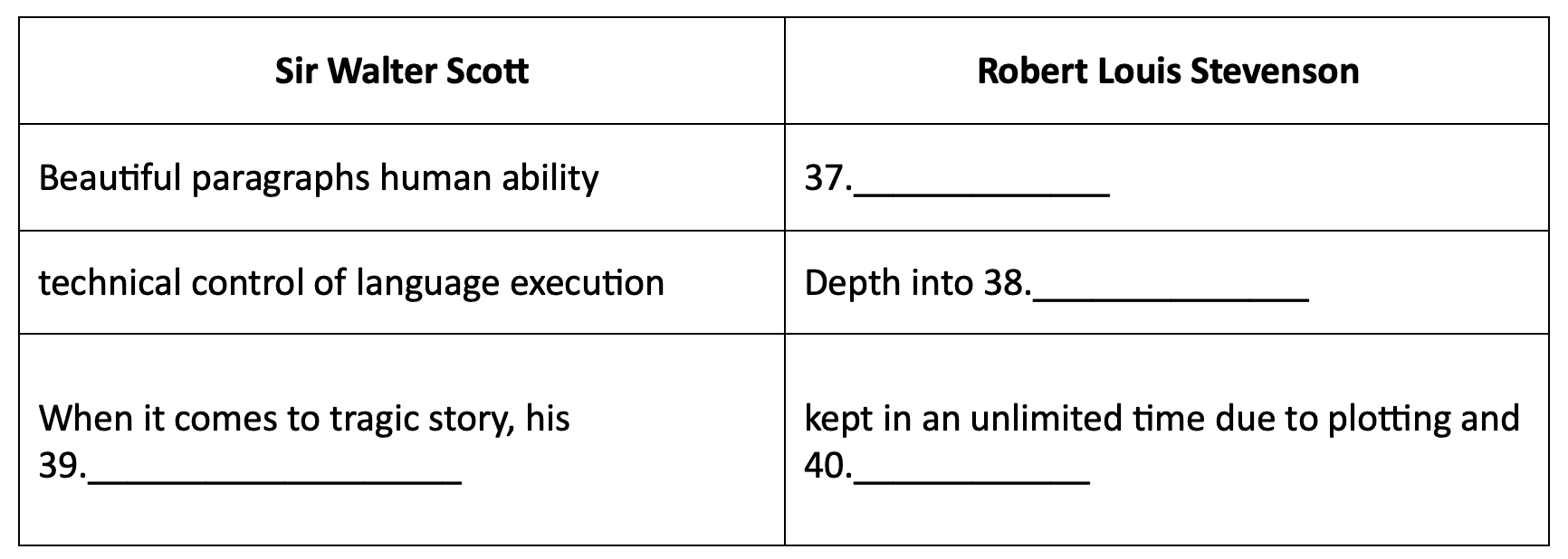
Despite Wilde’s criticism, Stevenson’s Scottish identity was an integral part of his written works. Although Stevenson’s works were not popular in Scotland when he was alive, many modern Scottish literary critics claim that Sir Walter Scott and Robert Louis Stevenson are the most influential writers in the history of Scotland. While many critics exalt Sir Walter Scott as a literary genius because of his technical ability, others argue that Stevenson deserves the same recognition for his natural ability to capture stories and characters in words. Many of Scott’s works were taken more seriously as literature for their depth due to their tragic themes, but fans of Stevenson praise his unique style of story-telling and capture of human nature. Stevenson’s works, unlike other British authors, captured the unique day to day life of average Scottish people. Many literary critics point to this as a flaw of his works. According to the critics, truly important literature should transcend local culture and stories. However, many critics praise the local taste of his literature. To this day, Stevenson’s works provide valuable insight to life in Scotland during the 19th century.
E
Despite much debate of Stevenson’s writing topics, his writing was not the only source of attention for critics. Stevenson’s personal life often attracted a lot of attention from his fans and critics alike. Some even argue that his personal life eventually outshone his writing. Stevenson had been plagued with health problems his whole life, and often had to live in much warmer climates than the cold, dreary weather of Scotland in order to recover. So he took his family to a south pacific island Samoa, which was a controversial decision at that time. However, Stevenson did not regret the decision. The sea air and thrill of adventure complimented the themes of his writing, and for a time restored his health. From there, Stevenson gained a love of travelling, and for nearly three years he wandered the eastern and central Pacific. Much of his works reflected this love of travel and adventure that Stevenson experienced in the Pacific islands. It was as a result of this biographical attention that the feeling grew that interest in Stevenson’s life had taken the place of interest in his works. Whether critics focus on his writing subjects, his religious beliefs, or his eccentric lifestyle of travel and adventure, people from the past and present have
different opinions about Stevenson as an author. Today, he remains a controversial yet widely popular figure in Western literature.
Choose the correct letter, A, B, C or D.
Write the correct letter in boxes 27-31 on your answer sheet.
27 Stevenson’s biographers KF and CP
A underestimated the role of family played in Stevenson’s life.
B overestimated the writer’s works in the literature history.
C exaggerated Stevenson’s religious belief in his works.
D elevated Stevenson’s role as a writer.
28 The main point of the second paragraph is
A the public give a more fair criticism to Stevenson’s works.
B recent criticism has been justified.
C the style of Stevenson’s works overweigh his faults in his life.
D Stevenson’s works’ drawback is lack of ethical nature.
29 According to the author, adventure stories
A do not provide plot twists well.
B cannot be used by writers to show moral values.
C are more fashionable art form.
D can be found in other’s works but not in Stevenson’s.
30 What does the author say about Stevenson’s works?
A They describe the life of people in Scotland.
B They are commonly regarded as real literature.
C They were popular during Stevenson’s life.
D They transcend the local culture and stories.
31 The lifestyle of Stevenson
A made his family envy him so much.
B should be responsible for his death.
C gained more attention from the public than his works.
D didn’t well prepare his life in Samoa.
Do the following statements agree with the information given in Reading Passage 3?
In boxes 32-35 on you answer sheet, write
TRUE if the statement is true
FALSE if the statement is false
NOT GIVEN if the information is not given in the passage
32 Although Oscar Wilde admired Robert Louis Stevenson very much, he believed Stevenson could have written greater works.
33 Robert Louis Stevenson encouraged Oscar Wilde to start writing at first.
34 Galsworthy thought Hardy is greater writer than Stevenson is.
35 Critics only paid attention to Robert Louis Stevenson’s writing topics.
Complete the notes using the list of words, A-I, below.
Write the correct letter, A-I, in boxes 36-40 on your answer sheet.
Sir Walter Scott and Robert Louis Stevenson
A lot of people believe that Sir Walter Scott and Robert Louis Stevenson are the most influential writer in the history of Scotland, but Sir Walter Scott is more proficient in 36………………………., while Stevenson has better 37……………………….. Scott’s books illustrate 38………………………. especially in terms of tragedy, but a lot of readers prefer Stevenson’s 39………………………. What’s more, Stevenson’s understanding of 40………………………. made his works have the most unique expression of Scottish people.
A natural ability
B romance
C colorful language
D critical acclaim
E humor
F technical control
G storytelling
H depth
I human nature
27. D
28. D
29. B
30. A
31. C
32. TRUE
33. NOT GIVEN
34. FALSE
35. FALSE
36. F
37. A
38. H
39. G
40. I
Robert Louis Stevenson, một tiểu thuyết gia, nhà thơ, nhà viết luận và viết về du ký người Scotland, sinh tại 8 Howard Place, Edinburgh, Scotland, vào ngày 13 tháng 11 năm 1850. Đã hơn 100 năm trôi qua kể từ ngày ông qua đời. Stevenson là một nhà văn đã gây ra những ý kiến trái chiều về các tác phẩm của mình. Một mặt, ông thường được nhiều nhà phê bình tiếng Anh đánh giá cao về văn phong và văn phong lão luyện. Mặt khác, những người khác chỉ trích chủ đề tôn giáo trong các tác phẩm của ông, thường hiểu sai niềm tin tôn giáo của chính Stevenson. Kể từ khi ông qua đời một thế kỷ trước, các nhà phê bình và viết tiểu sử đã bất đồng về di sản văn học của Stevenson. Hai nhà viết tiểu sử, KF và CP, đã viết tiểu sử về Stevenson với trọng tâm rõ ràng. Họ đã chọn không chỉ trích các khía cạnh trong cuộc sống cá nhân của Stevenson. Thay vào đó, họ tập trung vào bài viết của ông ấy và dành nhiều lời khen ngợi cho phong cách và kỹ năng viết của ông ấy.
Con lắc văn học đã đung đưa những ngày này. Các nhà phê bình khác nhau có ý kiến khác nhau đối với các tác phẩm của Robert Louis Stevenson. Mặc dù ngày nay, Stevenson là một trong những tác giả được dịch nhiều nhất trên thế giới, các tác phẩm của ông đã phải hứng chịu nhiều chỉ trích tiêu cực trong suốt cuộc đời của mình. Nó giống như một sự đảo ngược hoàn toàn các cực – từ rất tích cực sáng kém tích cực hơn một chút rồi đến tiêu cực rõ ràng; sau khi được đánh giá cao như một nhà văn lớn, ông ấy trở thành một ví dụ về một tác giả có đạo đức suy đồi và thiếu đạo đức. Nhiều nhà phê bình văn học coi các tác phẩm của ông là truyện thiếu nhi hoặc truyện kinh dị, và được cho là có ít giá trị xã hội trong môi trường giáo dục. Các tác phẩm của Stevenson thường bị loại khỏi chương trình giảng dạy văn học vì tính chất gây tranh cãi của nó. Những cuộc tranh luận này vẫn còn, và nhiều nhà phê bình vẫn khẳng định rằng bất chấp tài năng của ông, các tác phẩm văn học của ông vẫn thiếu giá trị đạo đức.
Một trong những lý do chính khiến các tác phẩm văn học của Stevenson bị chỉ trích nhiều như vậy là do thể loại sáng tác của ông. Stevenson chủ yếu viết truyện phiêu lưu, đây là một phần của trào lưu viết văn giải trí và phổ biến vào thời điểm đó. Nhiều người trong chúng ta tin rằng những câu chuyện phiêu lưu rất thú vị, có các nhân vật hấp dẫn, hành động và bí ẩn nhưng cuối cùng không thể dạy các nguyên tắc đạo đức. Các điểm cốt truyện là một chiều và hiếm khi mang lại ý nghĩa đạo đức sâu sắc hơn, thay vào đó tập trung vào các tình tiết ly kỳ và xoắn cốt truyện thú vị và gây sốc. Các tác phẩm của ông thậm chí còn bị chỉ trích bởi các tác giả đồng nghiệp. Mặc dù các tác phẩm của Stevenson có ảnh hưởng sâu sắc đến Oscar Wilde, nhưng Wilde thường nói đùa rằng Stevenson sẽ viết những tác phẩm hay hơn nếu ông không sinh ra ở Scotland. Các tác giả khác đã đứng ra bảo vệ Stevenson, bao gồm cả Galsworthy, người đã tuyên bố rằng Stevenson là một nhà văn vĩ đại hơn Thomas Hardy.
Bất chấp những lời chỉ trích của Wilde, bản sắc Scotland của Stevenson là một phần không thể thiếu trong các tác phẩm viết của ông. Mặc dù các tác phẩm của Stevenson không phổ biến ở Scotland khi ông còn sống, nhưng nhiều nhà phê bình văn học Scotland hiện đại cho rằng Ngài Walter Scott và Robert Louis Stevenson là những nhà văn có ảnh hưởng nhất trong lịch sử Scotland. Trong khi nhiều nhà phê bình ca ngợi Ngài Walter Scott là một thiên tài văn học vì khả năng kỹ thuật của ông, thì những người khác lại cho rằng Stevenson cũng xứng đáng được công nhận vì khả năng bẩm sinh của ông trong việc nắm bắt các câu chuyện và nhân vật bằng ngôn từ. Nhiều tác phẩm của Scott được coi là văn học nghiêm túc hơn vì chiều sâu do chủ đề bi thảm của chúng, nhưng những người hâm mộ Stevenson ca ngợi phong cách kể chuyện độc đáo và nắm bắt bản chất con người của ông. Các tác phẩm của Stevenson, không giống như các tác giả người Anh khác, ghi lại cuộc sống hàng ngày độc đáo của người dân Scotland bình thường. Nhiều nhà phê bình văn học coi đây là một lỗ hổng trong các tác phẩm của ông. Theo các nhà phê bình, văn học thực sự quan trọng nên vượt qua văn hóa địa phương và những câu chuyện. Tuy nhiên, nhiều nhà phê bình ca ngợi hương vị địa phương trong văn học của ông. Cho đến ngày nay, các tác phẩm của Stevenson cung cấp cái nhìn sâu sắc có giá trị về cuộc sống ở Scotland trong thế kỷ 19.
Mặc dù có nhiều tranh luận về các chủ đề viết lách của Stevenson, bài viết của ông không phải là nguồn chú ý duy nhất của các nhà phê bình. Cuộc sống cá nhân của Stevenson thường thu hút rất nhiều sự chú ý từ người hâm mộ cũng như các nhà phê bình. Một số người thậm chí còn cho rằng cuộc sống cá nhân của ông ấy cuối cùng đã vượt xa khả năng viết lách của ông ấy. Stevenson đã phải đối mặt với các vấn đề sức khỏe trong suốt cuộc đời mình và thường phải sống ở những vùng có khí hậu ấm áp hơn nhiều so với thời tiết lạnh giá, ảm đạm của Scotland để hồi phục. Vì vậy, ông ấy đã đưa gia đình đến hòn đảo Samoa ở nam Thái Bình Dương, đây là một quyết định gây tranh cãi vào thời điểm đó. Tuy nhiên, Stevenson không hối hận về quyết định này. Không khí biển và cảm giác hồi hộp của cuộc phiêu lưu đã khen ngợi chủ đề sáng tác của ông ấy, và trong một thời gian, sức khỏe của ông ấy đã phục hồi. Từ đó, Stevenson bắt đầu yêu thích du lịch và trong gần ba năm, ông đã lang thang ở phía đông và trung tâm Thái Bình Dương. Phần lớn các tác phẩm của ông phản ánh tình yêu du lịch và phiêu lưu mà Stevenson đã trải qua ở các đảo Thái Bình Dương. Kết quả của sự chú ý đến tiểu sử này là cảm giác ngày càng lớn rằng sự quan tâm đến cuộc đời của Stevenson đã thay thế sự quan tâm đến các tác phẩm của ông. Cho dù các nhà phê bình tập trung vào chủ đề sáng tác của ông, niềm tin tôn giáo hay lối sống lập dị thích du lịch và phiêu lưu của ông, những người trong quá khứ và hiện tại đều có những ý kiến khác nhau về Stevenson với tư cách là một tác giả. Ngày nay, ông vẫn là một nhân vật gây tranh cãi nhưng lại được yêu thích rộng rãi trong văn học phương Tây.
Robert Louis Stevenson
The writer of some of the best-known stories in the English language, including Treasure Island and the strange case of Dr. Jekyll and Mr. Hyde
A. It is more than 100 years since the death of the Scotland writer Robert Louis Stevenson on the South Pacific island of Samoa. And it seems that time has not been kind to Stevenson's memory. Immediately after his death, his family and friends set to work to fashion the legend of Robert Louis Stevenson, or R.I.S as he became known - one of the few writers familiar from his initials alone. Subsequent works of biography then turned him into a writer of almost religious importance. One example was history critic Balfour, who in 1901 portrayed Stevenson's family as ministering angels to the dying genius during his final illness. Similarly, the biographer Crouch absurdly overstated Stevenson's significance by placing in the same company as those most revered natures in English literature Shakespeare and Keats. The reaction to this nonsense was a number of highly critical assessments of Stevenson's legacy in the 1920s.
B. Normally, the critical pendulum can be relied on to swing back again, but there are several aspects of Stevenson's work that has until recently acted against a more balanced appraisal First is the allegation that Stevenson was a mere master of linguistic fireworks who lacked moral depth. Some critics accused him of being a literacy charlatan of juggling words very prettily to strike effects that overawed an ignorant public, and served to distract from the inadequacy of his ideas.
C. Then there has been a prejudice against the adventure story as the proper medium for deep moral seriousness, a prejudice which is still extremely influential today. It seems that we can accept that an adventure film can successfully express profound moral truths, but we reject the same idea for a book. The absurdity of this becomes apparent when we think of writers like Joseph Contrad and Graham Greene, but it is no use pretending that this bias against adventure stories is not part of our high culture. A further problem is that Stevenson has often not found favour in the land of his birth because his conservatism so often collides with the strong radical tradition in Scotland. His many escapist stories and preference for living abroad have led to accusations that he camouflaged Scotland^ real problems. Lastly, the high adventure of Stevenson's own lifestyle has sometimes obscured his output. His globe-trotting, and above all the final phase of his life in Samoa, tended to make his own life a greater story than any he could devise. This was precisely what his friends feared would happen towards the end of his short life: his art might be overwhelmed by the drama of life in Samoa.
D. One consequence of this has been that Stevenson's influence on other writers has too often been neglected. The writer and poet Oscar Wilde were deeply influenced by Stevenson, even though he declared that Stevenson would have produced better work if he had lived in London rather than Samoa. Stevenson tends to stick in the throat even of those writers who would like to spit him out, such as Shaw, who claimed to have learned from him that the romantic hero is always mocked by reality. Likewise, the writer Gatsworthy, who was a determined critic, later changed his mind and said that the superiority of Stevenson over the novelist Hardy was that Stevenson was all life and Hardy, all death. The influence on the novelist Chesterton would also repay detailed study, for it was through him that Stevenson has managed to cross the ages emerging as an influence on the modernist movement and our own contemporary Latin American school of magical realism.
E. When making an assessment of his life and work, one question must inevitably be asked: was Robert Louis Stevenson Scotland's greatest writer of English prose? For most commentators this honour falls to Sir Walter Scott, author of Ivanhoe among many other classic novels, and it is true that in terms of craftsmanship, precision and the ability to minutely regulate language to create the desired effect. Scott takes the prize. However, this is not the same thing at all as inherent talent: by way of comparison one may take the example of the two great Russian composers Shostakovich and Prokofiev, of whom the former had learned more precise skills of execution but the latter's intrinsic genius was greater, and so it seems to be with Scott and Stevenson. Admittedly, Scott's detailed style does permit his stories to explore levels of tragedy that are beyond Stevenson's reach, but in this regard they have the musty smell of the museum, somehow artificial and removed from modern-day reality. On the other hand, Stevenson's skill with plotting and narrative give his books a timeless quality, so that they still live today. And Stevenson was also the shrewder judge of behavior and psychology. For example, his compelling description of a man with a split personality in the Stranger cave of Dr. Jekyll and Mr. Hyde have proved so accessible and accurate that the expression 'Jekyll and Hyde' has entered common English usage. Even if we do not see a revival of critical interest in this great Scottish writer, it is to be hoped that readers go back to Robert Louis Stevenson's magnificent stories and reassess this neglected genius.
Choose the correct letter, A, B, C, or D.
Write your answers in boxes 27-31 on your answer sheet.
27. In the opinion of the writer, the biographers Balfour and Crouch
A. Misunderstood Stevenson's religious belief
B. Overestimated other writer influence on Stevenson
C. Elevated Stevenson above his true status as a writer
D. Understated the role played by Stevenson's family
28. What is the writer's main point about Stevenson in the Second paragraph
A. the ethical nature of his stories was often criticized
B. the public judges him more fairly than the critics
C. recent criticism of him has been justified
D. critics argued that his style covered up his faults
29. According to the writer, the adventure story
A. can be used by writers to tell moral stories
B. is more fashionable today than in the past
C. has been used by other writers but not Stevenson
D. is more appropriate for books than film
30. What point does the writer make about Stevenson and Scotland
A. His unflattering stories about Scotland angered many Scot
B. His ideas contrasted with those of many Scots
C. His demonstrated great sympathy for Scotland's problems
D. He was not considered a true Scot as he was not born there
31. According to the writer, Stevenson's own lifestyle
A. attracted more attrition than his books
B. did not prepare his for living in Samoa
C. was envied by his friends
D. was responsible for his early death
Do the following statements agree with the information given in Reading Passage 3? In boxes 32-36 on your answer sheet, write
YES if the statement agrees with the view of the writer
NO if the statement contradicts the view of the writer
NOT GIVEN if it is impossible to say what the writer thinks about this
32. Oscar Wilder believed Robert can write a better novel
33. Robert asked Shaw to keep writing
34. Robert's influence on other writers can be controversial
35.Galsworthy think Robert's work is better than writer Hardy
36. In this paper, the author is critical for Robert Louis Stevenson
Complete the table below.
Use the words form the list below, A-H, for each answer.
A. determined critic
B. natural ability
C. neglected genius
D. detailed style
E. human nature
F. English usage
G. escapist stories
H. story telling
27 D
28 D
29 B
30 A
31 C
32 YES
33 NOT GIVEN
34 NOT GIVEN
35 YES
36 NO
37 B
38 E
39 D
40 H