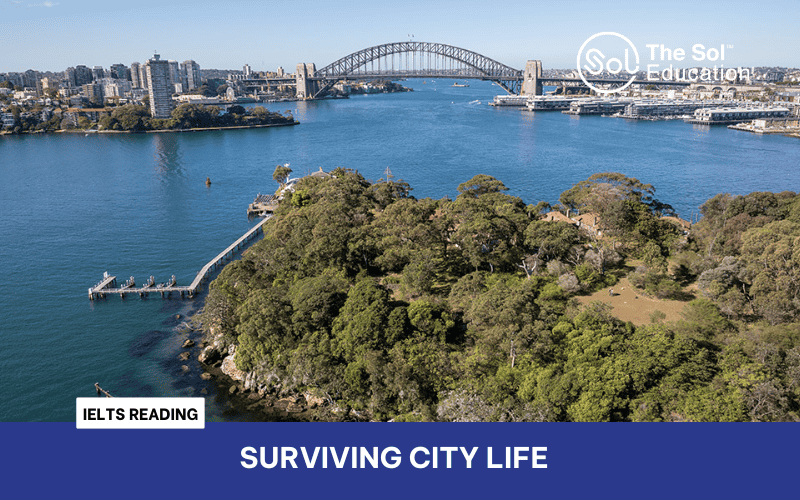
Although the colonisation of Australia profoundly affected the continent's natural environment, many plants and animals have actually flourished since European settlement. Some even thrive in the concrete jungle of Australia's biggest city, Sydney.
A
Ecologists often prefer to study plants and animals in exotic locations, but a growing number have turned their attention to the complex interactions of the wildlife that inhabits concrete jungles. Inner-city Sydney is the laboratory of choice for a number of ecologists, and their research is timely. More than half the world's human population resides in cities, and urban development continues to increase all over the world. By 2000, the United Nations projects five billion people will live in cities. Associate Professor Dieter Hochuli, a biologist at the University of Sydney, believes that we need to understand how cities are changing the ecology of the systems they are built on, and how plants and animals are adapting to them.
B
If any species has learnt to thrive in an urban environment, it's the native white ibis. A strange long-legged bird with a long bow-shaped beak, it is known as the 'garbage turkey'. The bird's reputation for digging through inner-city bins and scavenging street garbage has not endeared it to the public. The white ibis began its move to the city in the 1970s, when large parts of its natural habitat of inland wetlands became degraded due to years of low rainfall. The species is a wetland forager, wildlife officer John Martin, from Sydney's Royal Botanic Gardens, says. Now it happily forages in city parks and landfill. During the peak of its spring breeding season, there are more than 9,000 of these birds in Sydney.
C
Specimens at Sydney's Australian Museum show that the city's overall bird life has changed dramatically over the two centuries since colonisation. Prior to urban development, Sydney's native bushland was populated by large numbers of small insect-eating birds, such as the superb fairy-wren and the eastern yellow robin. Today, homeowners prefer to landscape their backyards with tall trees and manicured lawns, an environment that provides little protection for small birds. But one bird's trash is another's treasure. Gardens filled with flowering plants and fruit trees favour omnivorous birds such as currawongs, bowerbirds, and the city's most despised resident—the noisy miner bird. 'They're a real winner in cities,' Australian Museum ornithologist Richard Major says. 'The predominant driver in the decline of small birds is that we've made a suitable environment for native noisy miners.'
D
Many invertebrates, such as the golden orb weaver spider and the blue triangle butterfly, also relish living in the city. The golden orb spiders in Sydney are fatter and fitter than species found elsewhere, and Professor Hochuli and his team are trying to understand why. 'We're trying to determine whether it's more food or the urban heat, as it's up to four degrees warmer in the city.' Hochuli has also found some varieties of ant more at home in the city. The green ant, known for its painful bite, will build a nest where there is space and food, regardless of whether it's a backyard or a sports oval. 'It's remarkable how many things persist in city environments,' he says. The decline in birds that eat small invertebrates means these populations grow unchecked, allowing them to chew their way through the foliage of the city's trees.
E
While some species can survive in relatively small areas, mammals have been confined to patches of bushland scattered around Sydney and its nearby national parks. However, the rabbit-sized, long-nosed bandicoot has discovered the advantages of venturing out of Sydney Harbour National Park and into suburban gardens. 'They forage for invertebrates in the grass and like the surrounding habitat to nest and escape from predators,' Catherine Price, a research associate with the University of Sydney, says. Dr Price is trying to understand what encourages the little mammal into urban environments. 'We don't know if it's an overflow from the park, or if they've got particular survival traits that allow them to evade dogs and cats, and use the urban habitat that benefits them,' she says.
F
It's not just native wildlife that has sought comfort in city living. Non-native species such as black rodents, cockroaches and foxes have developed survival strategies too. But weeds are the pest that has gained the most advantage. 'In residential Sydney, there would not be a single area of remnant bushland not infested by introduced plants,' Michele Leishman, a Macquarie University plant biologist, says. Over 20 years, Leishman and her colleagues have shown how Sydney's huge stretches of impermeable concrete, together with the stormwater system, have helped weeds infiltrate the few remaining pockets of bushland. As rain washes over backyards and roadways, it collects chemicals which enter the stormwater system, where it is piped to the edges of bushland. The nutrient-rich water seeps into the earth, favouring the many exotic species that live fast and die young, Leishman says. Indigenous plants prefer a low-fertility soil and struggle to cope with one that is more fertile.
Reading Passage 2 has six paragraphs, A-F.
Choose the correct heading for each paragraph from the List of Headings below.
Write the correct number, i-viii, in boxes 14-19 on your answer sheet.
List of Headings
i. The behaviour of a small animal expanding its territory
ii. The urban environment encouraging the spread of imported flora and fauna
iii. Insects that thrive in urban areas
iv. A creature which likes rubbish
v. Creatures which change their shape and colour
vi. Why natural scientists are interested in studying urban wildlife
vii. Changes in the urban built environment encourage particular species
Look at the following statements (20-23) and the list of researchers below.
Match each statement with the correct researcher, A-D.
Write the correct letter, A-D, in boxes 20-23 on your answer sheet.
You may use any letter more than once.
List of Researchers
A. John Martin
B. Dieter Hochuli
C. Richard Major
D. Catherine Price
20 It is not clear why one small animal is moving from its natural environment.
21 Hot weather might positively affect the health of a species.
22 Sydney's residential gardens suit some species better than others.
23 Research into the natural world's responses to urban settings is vital.
Complete the summary below.
Choose ONE WORD ONLY from the passage for each answer.
Write your answers in boxes 24-26 on your answer sheet.
Seeking comfort in city living
It's not only native plants and animals that are adapting to city life: non-native plants and animals are also adapting. Examples of successful city dwellers include small, non-native 24. ______ and non-native insects such as 25. ______. However, what causes most problems in the city is weeds. Michelle Leishman, a scientist from Macquarie University, has proven that Sydney's large areas of 26. ______ and its drainage network favour the growth of weeds. Water gathers chemicals as it passes from gardens and streets into the city drainage network. This, in turn, creates very good soil for several varieties of rapidly growing non-native plants.
14. Paragraph A → vi. Why natural scientists are interested in studying urban wildlife
Keywords đoạn A:
Ecologists study wildlife in cities
Need to understand how cities change ecology
How plants & animals adapt
→ Đoạn A nói về lý do các nhà khoa học nghiên cứu động vật đô thị.
Đáp án: vi
15. Paragraph B → iv. A creature which likes rubbish
Keywords đoạn B:
White ibis = “garbage turkey”
Digs through bins, scavenges garbage
Thrives in city
→ Ý chính: một loài chim thích rác.
Đáp án: iv
16. Paragraph C → vii. Changes in the urban built environment encourage particular species
Keywords đoạn C:
Backyards with tall trees & lawns → bad for small birds
Flowering plants → good for omnivorous birds
Noisy miner thrives
→ Môi trường đô thị thay đổi → loài này giảm, loài kia tăng.
Đáp án: vii
17. Paragraph D → iii. Insects that thrive in urban areas
Keywords đoạn D:
Golden orb spider → fatter & fitter in city
Blue triangle butterfly
Ants thrive
Decline of birds → insects increase
→ Đoạn này nói về côn trùng phát triển mạnh trong đô thị.
Đáp án: iii
18. Paragraph E → i. The behaviour of a small animal expanding its territory
Keywords đoạn E:
Bandicoot moves from national park → suburban gardens
Not sure why
Expanding territory
→ Một loài thú nhỏ đang mở rộng vùng sống.
Đáp án: i
19. Paragraph F → ii. The urban environment encouraging the spread of imported flora and fauna
Keywords đoạn F:
Non-native rodents, cockroaches, foxes
Weeds spread due to concrete + stormwater
Exotic plants thrive
→ Đoạn này nói về loài ngoại lai phát triển nhờ môi trường đô thị.
Đáp án: ii
20. It is not clear why one small animal is moving from its natural environment.
Đoạn E – Catherine Price:
“We don’t know if it’s an overflow… or survival traits…”
→ Không rõ vì sao bandicoot rời công viên.
Đáp án: D (Catherine Price)
21. Hot weather might positively affect the health of a species.
Đoạn D – Hochuli:
“trying to determine whether it’s more food or urban heat… spiders are fatter and fitter.”
→ Nhiệt độ đô thị có thể giúp nhện khỏe hơn.
Đáp án: B (Dieter Hochuli)
22. Sydney's residential gardens suit some species better than others.
Đoạn C – Richard Major:
“Gardens… favour omnivorous birds… decline of small birds…”
→ Vườn nhà phù hợp loài này nhưng không phù hợp loài khác.
Đáp án: C (Richard Major)
23. Research into the natural world's responses to urban settings is vital.
Đoạn A – Hochuli:
“we need to understand how cities are changing ecology…”
→ Nghiên cứu này rất quan trọng.
Đáp án: B (Dieter Hochuli)
24. small, non-native ______
Đoạn F:
“Non-native species such as black rodents, cockroaches and foxes…”
→ Loài nhỏ, không bản địa = rodents.
Đáp án: rodents
25. non-native insects such as ______
Cùng đoạn F:
“cockroaches”
Đáp án: cockroaches
26. Sydney’s large areas of ______
Đoạn F:
“Sydney’s huge stretches of impermeable concrete…”
→ Từ cần điền: concrete.
Đáp án: concrete